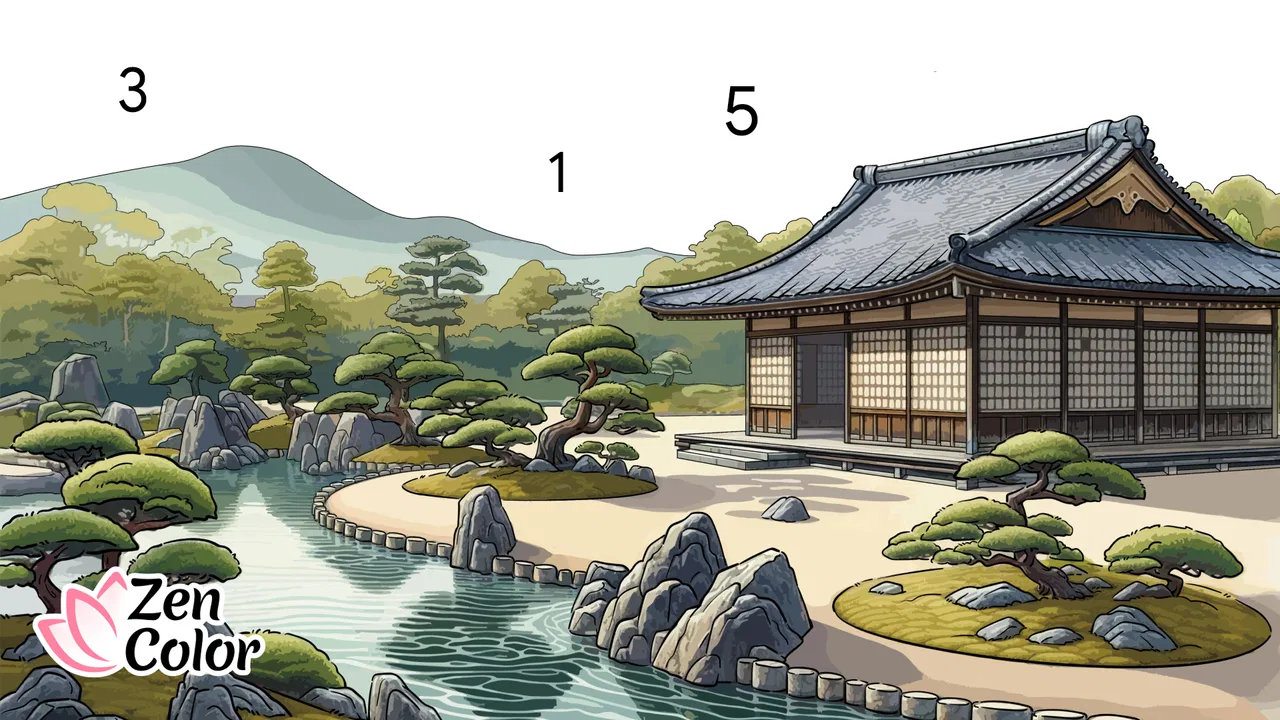
Zen Color - Color By Number
- 4.6
- Rating
- 1.00M
- Installs
- Free
- Price

 Analysis by App-foxy
I usually approach coloring games as a short break rather than a serious hobby, so I paid close attention to whether Zen Color - Color By Number gives me a reason to return after the first few pictures. My overall impression is positive: this is a calm casual game from Oakever Games that makes progress feel gentle instead of demanding. It is free to start, suitable for Everyone, and its Zen-inspired presentation clearly aims at relaxation rather than competition.
The important distinction is that the game’s appeal is not simply “tap colors until an image appears.” The satisfying part is the gradual change from a mostly blank, segmented picture into something complete. That makes it a good fit for quiet moments when I want a small task with a visible ending. It is less suitable if I need a deep puzzle, a story, or a strong competitive reason to keep playing.
How the coloring loop creates small, clear goals
The first useful goal is immediate and understandable: choose a picture and begin filling its numbered areas. I never had to learn a complicated control scheme before getting started. That simplicity matters on a phone, especially when I am using the game for a few minutes between other activities. The picture itself provides the objective, while each completed area gives enough feedback to make the next tap feel worthwhile.
You May Also Like

 Blood Strike: 2.5 Anniversary
Blood Strike’s Loadouts Turn Every Drop Into a Tactical Gamble
A close look at Blood Strike’s custom loadouts: how fast access to signature weapons reshapes its battle royale rhythm, rewards preparation, and narrows the gap between fights.

 Pandora - Music & Podcasts
Pandora’s Music Is Easy to Start, but Harder to Recover
Pandora’s strength is its low-effort path from a seed to a station. Its weak spot is how much confidence it asks you to place in connection, setup, and quiet recovery.

 8 Ball Pool
 Is Built on Rivalries, Rematches, and Routine
A close look at the rivalries, rematches, shared routines, and unanswered safety questions that turn a quick pool match into a persistent mobile community.

 Samsung Music
’s Quiet Strength Is Playing What You Already Own
Its reach comes less from spectacle than from dependable access to a personal library. That simplicity is both the app’s strongest retention engine and its ceiling.

 AccuWeather: Weather Radar
AccuWeather Review: A Quick, Clear Forecast for Everyday Decisions
For everyday plans, the best forecast is the one you can understand quickly. AccuWeather makes rain timing, radar, and local conditions easy to act on, with a few trade-offs.

 Hill Climb Racing
Why Hill Climb Racing Still Turns Crashes Into One More Run
A tiny car, a bumpy hill and one more upgrade: Hill Climb Racing keeps resurfacing because its simple chaos makes every near-miss feel personal.
More From Our News Desk



What works well is the way the game breaks a large image into many manageable decisions. I can focus on one color, one section, or one small cluster rather than thinking about the whole illustration at once. This creates a comfortable rhythm: locate a matching area, fill it, notice the image becoming clearer, and move on. The early experience is therefore less about mastery and more about establishing a dependable sense of completion.
I found this especially useful during an ordinary evening when I wanted to step away from a busier game without going straight to social media. A single coloring session can fit into a short pause, but it can also stretch longer when I am in the mood to finish an image. That flexible pacing is one of the strongest reasons I would recommend trying it.
The game also benefits from keeping the first objective concrete. Instead of asking me to understand a story or optimize a build, it asks me to complete a visual task. For people who enjoy checklists, tidy layouts, and gradual transformation, that is a surprisingly effective hook. The finished image acts as the reward I can see, rather than an abstract score that disappears when the next round begins.
There is a trade-off here. Because the basic goal is so clear, the novelty depends heavily on how much I enjoy the artwork and the act of coloring itself. Someone who needs changing rules or increasingly complex decisions may find the opening hours too gentle. I would not choose this as my main game if I wanted a demanding mental workout.
Progress is visible even when the game stays quiet
Zen Color communicates progress primarily through the artwork taking shape. That is a better match for its relaxing identity than loud victory screens or constant competitive prompts would be. I can tell that I am moving forward simply by looking at the picture: empty sections shrink, colored regions connect, and the final composition becomes easier to recognize.
This visual progress has an important psychological advantage. Even a small session can feel complete because I have changed the image in a noticeable way. In many casual games, progress is represented by a number that only matters inside the game. Here, the picture itself is the progress signal, so the result feels more personal and tangible.
My practical tip is to avoid treating every picture as a race. I get more from the game when I pick a comfortable section and work steadily instead of jumping around just to clear areas quickly. If I am using it to relax, I also prefer to pause after completing a meaningful portion rather than forcing myself to finish an image when I am tired. The design supports that kind of stop-and-start use better than a game built around streaks or timed rounds would.
Another useful approach is to alternate between broad progress and detail work. Filling larger, obvious areas first can make the image recognizable sooner, while returning to smaller spaces later gives the final stage a more careful, almost meditative quality. This is not a separate mode or a hidden system; it is simply a way to use the coloring structure more deliberately.
The game’s store reputation suggests that this straightforward loop is connecting with many players. It holds a 4.8 average from 748 ratings, and it has passed 100K+ installs. I see those figures as evidence of broad interest rather than proof that every player will enjoy it. Coloring games are personal: the same calm pacing that helps one person unwind can feel slow to another.
Difficulty stays approachable, with a ceiling for patient players
The difficulty curve is best understood as a gradual increase in attention rather than a sharp test of skill. The fundamental action remains accessible, but more intricate pictures can ask me to concentrate on smaller regions and track colors more carefully. That gives the game a modest sense of growth without abandoning its casual character.
I appreciate that this kind of challenge does not punish me for being slow. There is no need to react quickly or memorize a complicated sequence. My challenge is mainly visual patience: finding the right spaces, avoiding careless taps, and maintaining focus as the image becomes more detailed. That makes the game welcoming for people who prefer low-pressure activities.
At the same time, I would not describe the difficulty as a substitute for traditional puzzle design. The core decisions remain limited, so experienced players looking for deduction, strategy, or escalating mechanical complexity may reach the game’s ceiling quickly. A dedicated puzzle title will offer more meaningful problem-solving. Zen Color is better at creating a calm flow than at testing analytical ability.
One of the more useful ways to judge the difficulty is to match the picture to my energy level. When I am distracted, a simpler image works better because I can enjoy visible progress without losing my place. When I have more patience, a denser design provides a longer, quieter activity. That choice helps prevent the game from feeling either too demanding or too empty.
The minimum operating requirement is Android 7.0, which makes the game accessible to people using older Android devices. The current version is 2.0.2, and the game was released on February 24, 2026. For someone deciding whether to install it, those details make it easier to judge basic compatibility before committing time to the experience.
What keeps me returning, and where retention can feel thin
The main retention pressure is gentle rather than aggressive. I return because an unfinished picture remains a simple, approachable task, and because completing one image creates a natural reason to look at another. The loop encourages continuation through curiosity and visual completion instead of making me feel that I must protect a streak or keep up with other players.
That is a strength for relaxed use, but it also reveals the game’s main limitation. If I am not especially interested in the available artwork, the motivation to continue can weaken quickly. The experience does not have the same built-in pull as a collection game with a story, a competitive ladder, or a character progression system. Its long-term appeal depends on whether the act of coloring remains satisfying for me.
I also think the free-to-play structure deserves a careful look. The game is free, while in-app purchases are listed at $9.99 per item. That does not automatically make the experience unsuitable, but it means I would pay attention to how optional purchases fit into my own habits. For a casual coloring game, I would personally avoid spending impulsively and first decide whether I am still enjoying the free experience after several sessions.
This is particularly relevant for parents choosing an Everyone-rated game. The age rating makes the content broadly approachable, but adults may still want to supervise purchasing on a shared device. The safest approach is to treat the game as a free activity first and consider any purchase only after deciding that the artwork and pacing genuinely justify it.
Another retention consideration is session length. The game works well when I have five or ten quiet minutes, but it does not necessarily create a strong reason to play for a long uninterrupted stretch. I see that as a positive if I want healthier boundaries around casual gaming. It is a weakness only if I expect a constantly escalating stream of goals.
Who will enjoy it, and who should choose something else
I would recommend Zen Color - Color By Number to anyone who likes visual completion, quiet repetition, and simple phone activities that can be paused easily. It is a good companion for a commute, a wind-down period, or a short break after work. People who enjoy coloring books but want the convenience of a mobile format should find the basic idea familiar without needing physical supplies.
It may also suit players who become overwhelmed by games with too many menus, currencies, missions, or simultaneous objectives. Here, the picture keeps the focus narrow. I can open the game, choose what to work on, and begin without preparing a strategy. That low entry cost is a real advantage for casual players and for anyone who does not want to spend a break learning systems.
I would steer competitive players elsewhere. If your favorite part of a game is beating a timer, climbing a leaderboard, solving layered puzzles, or coordinating with other people, this will probably feel underpowered. A traditional puzzle game offers more intellectual resistance, while a competitive casual game provides stronger external motivation. Zen Color is intentionally softer than both.
I would also hesitate to recommend it to someone who dislikes repetitive tapping or who needs every session to introduce a new mechanic. The game’s consistency is the point, and that consistency can become monotony if the coloring action itself does not hold your attention. The best match is a player who values atmosphere and completion more than surprise.
Compared with a physical coloring book, the mobile format is more convenient and easier to carry, but it may feel less tactile. Compared with a general digital painting app, it provides more structure because the numbered spaces guide the process, but it gives me less freedom to create an image from scratch. Compared with a standard puzzle game, it offers less reasoning and more visual calm. Those differences make the choice fairly clear.
My verdict on the progression and everyday value
Oakever Games has built a casual experience whose progression is modest but coherent. The early goals are easy to understand, the artwork provides a visible progress meter, and the challenge grows mainly through attention to detail. The pacing avoids turning relaxation into pressure, although that same restraint limits how compelling the game will be for players who want deeper systems.
For me, the strongest use case is a short, repeatable reset. I can use it when I want something more active than watching a video but less demanding than a puzzle or action game. The ability to make visible progress without needing a long session gives it a practical place in a daily routine.
The game is free and rated for Everyone, but the listed $9.99-per-item in-app purchases mean I would approach spending carefully. Its broad audience, 100K+ installs, and 4.8 average from 748 ratings show that the concept has found a receptive audience, while the 117 reviews add further evidence that players are discussing the experience. I would still judge it by my own tolerance for repetition rather than by popularity alone.
My final recommendation is straightforward: try it if you want a calm coloring game with clear visual goals and forgiving pacing. Give it a pass if you need strategy, competition, narrative progression, or constant mechanical variety. The progression succeeds because it makes small improvements feel complete without turning every session into a demand. That is not a flashy promise, but it is exactly why I can imagine returning to it when I need a quiet few minutes.
FAQs for Zen Color - Color By Number
01What is Zen Color - Color By Number?
Zen Color - Color By Number is a relaxing and creative app that allows users to de-stress by coloring various images using a simple number system. Each number corresponds to a specific color, making it easy for anyone to create beautiful artwork without needing advanced artistic skills.
02Is Zen Color - Color By Number free to use?
The app is free to download and offers a selection of images that can be colored without cost. However, it does include optional in-app purchases and subscriptions that offer additional features and premium content for a more enhanced experience.
03Can I use Zen Color - Color By Number offline?
Yes, Zen Color - Color By Number can be used offline. Once you have downloaded the images you'd like to color, you can access them without an internet connection, making it a great option for on-the-go relaxation and creativity.
04What devices are compatible with Zen Color - Color By Number?
Zen Color - Color By Number is available on both Android and iOS devices. It is compatible with most smartphones and tablets running the latest operating systems, ensuring a smooth and enjoyable user experience across various platforms.
05Are there any social features in Zen Color - Color By Number?
Yes, Zen Color - Color By Number includes social features that allow users to share their completed artwork with friends and family. You can easily post your creations on social media platforms or save them to your device's gallery to showcase your artistic achievements.
Pros
- Wide variety of coloring templates.
- Intuitive user interface.
- Regular updates with new content.
- Offline mode available.
- Relaxing and stress-reducing.
Cons
- Limited free features.
- Contains ads in free version.
- Requires internet for some features.
- Premium subscription can be pricey.
- Occasional app crashes.

Zen Color - Color By Number
Gallery